
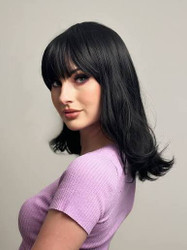
Black Hair Wig Looks Harsh? Check 7 Details That Matter
3rd Oct 2026
Black Hair Wig Looks Too Harsh? Check 7 Quality Details First
A black hair wig can look severe even when the shade is right. High luster, packed roots, blunt ends, or heavy fringe can strengthen the whole look.
Before buying, inspect seven build details: shade depth, fiber luster, root density, front weight, end taper, texture, and cap construction. Those details control the finished effect.
Why Black Shows Construction Faster Than Lighter Shades
A dark hair wig in black shade creates strong contrast at the scalp, fringe, and ends. Uniform density or hard cut lines can therefore become easier to notice.
Judge black wig quality at the roots, mid-lengths, and tips. Fiber softness feels pleasant, but softness alone does not guarantee realistic density, movement, or parting.
1. Check the Black Shade Code, Not Just the Photo
With black hair wigs, shade depth changes the result. Jet black reads stronger, while natural black or off-black usually shows softer depth under daylight.
Use the shade specification in the black wig collection before judging photographs, because screen brightness and studio lighting can hide subtle undertones.
Check these before choosing:
- Jet Black, Natural Black, or another dark tone
- Indoor and brighter product photos
- Whether the roots and lengths are one flat shade
- Whether the style is for costume or everyday wear
- Whether your natural hair must blend with the wig
2. Read the Fiber Luster Before You Judge Quality
A long black hair wig can show bright reflection bands more clearly than textured hair. Smooth dark fiber creates a larger continuous surface for light to catch.
Use this photo test:
- Inspect the crown under direct light
- Look for identical shine across every strand
- Compare bright and softer lighting
- Check whether texture breaks up reflection
- Inspect whether the ends look soft or plastic-stiff
- Avoid assuming “high heat” means “natural looking”
Heat resistance describes styling tolerance, not realism. A natural finish still depends on controlled luster, root density, part construction, movement, and soft-looking ends.
3. Inspect Root Density Where Black Can Look Too Solid
A black bob wig can look polished at the ends but heavy at the crown when the root area is packed too tightly.
The black bob wig range includes simple costume constructions and more advanced caps, making root spacing and part design worth checking before price alone.
Look closely at the root area:
- Is a believable part visible?
- Does the crown sit close to the head?
- Can you see separation between fibers?
- Is the front edge packed too densely?
- Does the density suit a bob, pixie, or longer cut?
- Is crown volume intentional or just bulk?
4. Treat Bangs and Fringe as a Density Decision
A black wig with bangs places dark fiber directly across the forehead. Thick, wide, blunt bangs can make an otherwise balanced wig look visually heavier.
Check the front like a wig maker would:
- Fringe width
- Fiber quantity through the bangs
- Feathered versus blunt ends
- Side connection into the temples
- Amount of forehead left visible
- Whether the fringe is fixed or can sweep sideways
A dense fringe can be intentional. Compare black bangs and black fringe styles for Cleopatra, goth, or other costume styling.
5. Check Whether the Ends Are Tapered or Cut Like a Block
A black long wig creates more uninterrupted dark color. A short black wig can still look severe when blunt ends make the lower edge thick and square.
Inspect the lower half for:
- Layering through the lengths
- Tapered versus blunt ends
- Face-framing sections
- Heavy weight around the jaw
- Natural separation at the tips
- Uneven or overly perfect cut lines
For extra length without a solid wall of color, compare layered or waved long black wigs instead of choosing by inches alone.
6. Match Texture to the Shape You Actually Want
A black curly wig uses movement to break up dark color. A black afro wig needs different checks: coil definition, even density, shape balance, and recovery.
Black Wig Style |
Manufacturing Detail to Inspect |
|---|---|
|
Straight |
Luster, part definition, end taper |
|
Black bob |
Crown height, bluntness, fringe weight |
|
Black curly wig |
Curl separation, frizz, pattern consistency |
|
Black afro wig |
Coil definition, round form, density balance |
|
Long waves |
Layer movement, weight, fiber reflection |
The black afro wig range is useful when deliberate rounded volume is the goal, rather than a reduced-density everyday silhouette.
7. Look Under the Hair at the Cap Construction
Good black hairstyle wigs should also be judged underneath. Cap construction affects root height, parting freedom, crown volume, hairline softness, and how independently strands move.
Know what each feature changes:
- Lace front: creates a softer visible hairline
- Monofilament: gives a scalp-like parting area
- Hand-tied: allows more independent movement
- Wefted cap: creates efficient structure and volume
- Traditional cap: useful for fixed, ready-shaped styles
- Adjustable straps: improve fit, not root realism
The CASSIE long black lace front wig combines several premium features. Simpler caps can still suit fixed costume styling and tighter budgets.
Do Not Use Price or Heat Resistance as a Shortcut
A premium black-haired wig should be judged by construction, not one label. Higher price or heat tolerance does not automatically soften a heavy hairline.
Look for features that solve your actual problem. A costume wig may need shape retention, while an everyday style may benefit more from part realism and movement.
Do not treat these as automatic quality scores:
- Highest heat rating
- Maximum density
- Longest length
- Human hair label alone
- Most expensive cap
- Darkest available black
Run a Product-Photo Stress Test Before Checkout
Treat a black-haired wig photo like a factory sample review. Check consistency across the crown, sides, back, part, hairline, and ends before deciding.
Check at least these views:
- Front hairline
- Top or part
- Both side profiles
- Back density
- Ends against clothing
- Crown under brighter light
- Texture after movement
If only one polished angle is available, rely more heavily on listed fiber, cap, length, and construction specifications.
Use a Factory-Style Seven-Point Buying Check
The strongest black hair wig is not automatically the darkest or fullest. Before ordering, score seven construction details instead of reacting only to color or model photos.
Check |
What You Want to Confirm |
|---|---|
|
Shade |
Depth suits the intended finish |
|
Fiber |
Luster matches everyday or costume use |
|
Roots |
Density does not form a dark wall |
|
Front |
Bangs or hairline suit the style |
|
Ends |
Taper or bluntness looks intentional |
|
Texture |
Pattern holds the right silhouette |
|
Cap |
Construction supports movement and parting |
A seller that provides clear fiber, cap, length, heat, and multiple-angle information makes these checks easier before purchase.
Choose Strong Black on Purpose, Not by Accident
A black hair wig does not need to look soft to be good. A jet-black bob, full afro, blunt fringe, or extra-long straight style can be intentionally dramatic.
At The Wig Outlet, black styles range from costume bobs to lace-front fashion wigs. Check the build first, then choose how strong you want black to look.
For a softer finish, prioritize:
- Natural or off-black depth
- Controlled fiber luster
- Visible part separation
- Lighter front density
- Layers or textured movement
- Tapered ends
- Lace or monofilament where useful
For a stronger fashion or costume finish, prioritize:
- Jet-black depth
- Clean blunt lines
- Fuller silhouette
- Defined bangs or fringe
- Strong curl or afro shape
- Structured crown volume